Wednesday, June 5, 2013

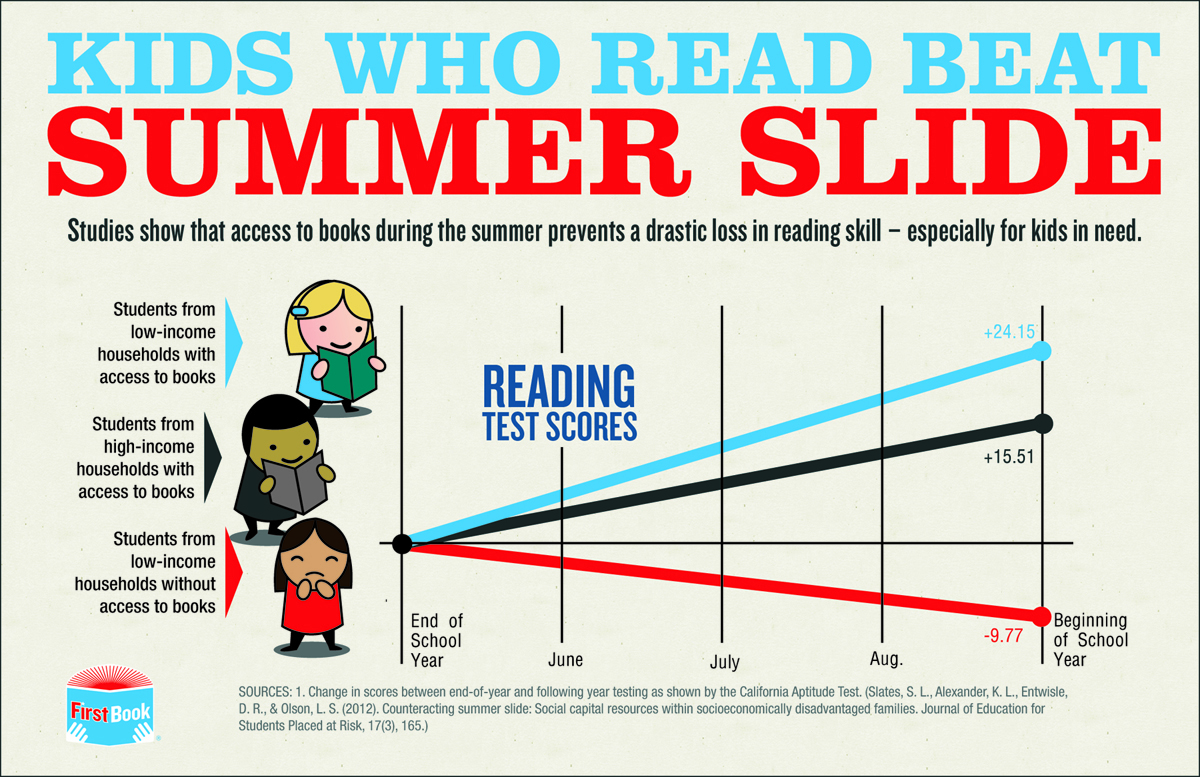
Kids who read beat "summer slide"


Reading during the summer helps kids maintain or even increase reading test scores — especially kids in low-income households. You can help stop the "summer slide" by donating to First Book, where $2.50 pays for a brand-new book for a child in need, and 97 percent of all revenue goes directly to providing books.

Labels: , , , ,

Monday, September 20, 2010

What Nicholas Sparks means in a dating profile

1. Joey Comeau analyzes five books you never want to see listed as a favorite on someone’s dating site.

His choices imply a libertine balance. He thinks anything by Ayn Rand and the Bible are red flags. (I couldn’t get through Atlas Shrugged with a thirty-aught-six, but the Bible has some lovely literature in it. Regardless of religion, I think everyone should read Ecclesiastes.)

He rightfully warns people of The Notebook. Comeau’s take: This is either the kind of (expletive deleted) guy who puts Nicholas Sparks on his profile to seem sensitive, or the kind of (expletive deleted) girl who falls for it.

I’d be nervous about anyone who likes Sweet Valley High or Kerouac. Also, it’s cool like to comics. (No, it is. Samuel L. Jackson said so at Comicon.) But I wouldn’t categorize “anything Batman” as one of my favorites.

2. Mental_floss lists seven things you might not know about Dr. Seuss.

Favorite fact: Seuss worked the word “contraceptive” into the original text of Hop on Pop to make sure his editor read it.

3. Apparently, people hate The Giving Tree.

What a shock. People don’t understand the concept of altruism.

4. Apparently, it’s Roald Dahl day or month or something. In honor of that, Philip Ardagh lists his ten favorite Dahl books. (My favorite, BFG, barely made the list.)

5. Speaking of Jane Austen (we’re always speaking of Jane Austen,) the Austen Fiction Manuscripts Project allows us to read Austen’s handwritten manuscripts. The site doesn't have her best known stuff (Emma, Pride and Prejudice) uploaded but it does have Persuasion.

-Jason Lea, JLea@News-Herald.com

Labels: , , , ,

Wednesday, August 4, 2010

The Best of Twitter

om•pha•lo•skep•sis (äm´fә lō skep´sis) n. [omphalo- + Gr. Skepsis, a viewing: for base see SKEPTIC] 1. the act of contemplating one’s navel, as an exercise for mystics 2. Tweeting

Twitter has several uses, despite tweeters’ inclination toward navel-gazing.

For example, what’s better than Kanye West’s banal tweets? Kanye’s banal tweets paired with New Yorker cartoons.


Yes, these are authentic Kanye tweets paired with real New Yorker cartoons. Here’s a convenient Flickr gallery with them all.

Paul Sabourin, the mastermind behind #kanyenewyorkertweets, offered two explanations why the juxtaposition works during an interview with Urlesque.

“The pretentious explanation: Kanye's tweets are more or less raw id (unfiltered, portraying base emotions and simple thoughts) and New Yorker cartoons are almost entirely superego (carefully considered, 'quiet' presentation).

"The simple explanation: it just struck me as funny at 3 a.m. Luckily, unlike most 3 a.m. inspirations, this one actually seems to hold up.”

Some of my favorite Sabourin compositions play on slang, like this:


Or this:


Another Twitter use: Susan Orlean was tired of reading Magic Treehouse to her 5-and-a-half-year-old son, so she turned to her Twitter page for suggestions.

Orlean is one of the more successful authors on Twitter (in terms of both follower numbers and quality of Tweets.) She’s in that Colson-Whitehead, Neil-Gaiman, Stephen-Fry range.

She has more than 67,000 followers on Twitter and asked them what books they would recommend for her son, using the hashtag #booksthatchangekidsworlds. Her followers offered more than 250 suggestions, including my favorite book as a child, The Phantom Tollbooth.

Orlean later said on her blog, “What I have loved about reading through them is not just the great suggestions for my son but the shiver of pleasure I get each time I see a title that meant everything to me when I was a kid but that I haven’t thought about in years. I actually gasped when someone recommended Hailstones and Halibut Bones, by Mary O’Neil, a book I wore out twice when I was little but haven’t thought about in decades; I can’t wait to read it to my son, to see if it will change his world the way it changed mine.”

Carolyn Kellogg commented on the LA Times Book Blog, “Having someone like Susan Orlean on the Internet, blogging and tweeting about everything from her chickens (an unlaid egg led to lamaze-style ablutions) to books is a treat. It's like getting seated next to her on a plane on a day when she happens to be feeling chatty, or finding that she's in the office right next to you and wants to know what you think about donkeys.”

People post a lot of helpful links for writers on Twitter, but they also post a lot of other crap, too. I mean A LOT of worthless stuff you will never use.

Fortunately, Jane Friedman of The Writer’s Digest sifts through the stupid and provides the best tweets for writers each week.

Jason Lea, JLea@News-Herald.com

Labels: , ,

Friday, March 5, 2010

Finnegans Wake, now with slightly more coherance

Textual scholars have compiled an amended version of Finnegans Wake.

Good, this will give Joycean scholars something to discuss and the rest of us something to ignore.

It’s Friday. Behold the melange.

Danis Rose and John O’Hanlon spent 30 years pouring over drafts of James Joyce’s least comprehensible work. Their research lead to 9,000 alterations in the amended Finnegans Wake.

In an interview, Rose said, “Thus the unfacts, did we possess them, are too imprecisely few to warrant our certitude.”

No, he didn’t. But that would be awesome. What Rose actually said:

Because of the difficulty of the language of Finnegans Wake, the syntax is not immediately apparent and the syntaxical coherence of the book was effectively lost when it was brought into print. This coherence has been fully restored in the new edition and results in what can be called the first definitive edition of Joyce’s final masterpiece.

Actually, the syntaxical coherence was lost when Joyce wrote the book; and you couldn’t restore its coherence with a decoder ring and a babelfish.

Moving right along: We didn’t write anything about Dr. Seuss’s birthday this year. (It was Tuesday.) As consolation, I offer Shirley Hughes’s top 10 picture book characters. (No Dr. Seuss characters make the cut, but Babar does.)

I have nothing to say about Charles Pellegrino that hasn’t already been said. I will grit my teeth when he receives a six-figure advance for his next book.

Finally, The New York Times explains e-book pricing.

-Jason Lea, JLea@News-Herald

P.S. For the record, Tricia’s absolutely right. It was jarring to have to stop every few pages of Moby Dick and write my thoughts. By the second day, I decided to only blog between chapters. It felt like less of an interruption, then.

If anything, I underestimated the physical challenge of trying to read for 13 consecutive hours.

Labels: , , , , , , ,

Sunday, February 21, 2010

The kids are all right

I know I’m a hack.

I work with a fistful of writers who are better than me, know several more personally and seem to be reading them all the time.

But it’s humbling to find a slew of middle schoolers more creative than me.

I covered the Power of the Pen competition Saturday in Painesville. Some of these seventh and eighth graders are fantastic writers. I don’t mean “fantastic for their age.” I mean they are better than me now.

Yes, some of them spend of the bulk of their time writing about “princesses and butterflies,” as one competitor put it. But they also tackle some issues I wouldn’t have considered until I was about a decade older.

They wrote about loss, regret and suicide — not in a maudlin or tactless way either. And they weren’t just creative in what stories they told, they found unusual ways to tell them. When prompted with the theme of “summer camp,” one teen narrated her story from the perspective of a filthy mattress lying on the ground.

I loved talking to the kids too. In general, writers are fun to interview because they tend to have unique perspectives and a way with language. Moreover, kids are the best interview subjects, because they haven’t learned how to speak in cliches yet.

For example, take this chestnut from eighth grader Megan Cerbin. She said this when I asked her what her favorite thing about writing was.

“I like that I can be myself. I can’t always be myself with people in real life. There are a lot of things in life that get in the way, a lot of everyday things. With writing — I can be real. I can be myself. I can write about whatever I want, and I don’t have to worry about what other people are going to think of me. I can just write.”

For someone who said she has trouble being herself, that’s raw honesty.
I think a lot of writers feel like Megan. We’re always restraining the crazy or the funny or the sad, because we think someone might not get it. But when we write, we can let our freak flag fly.

Thank you, Megan. Thank you to all of the kids who wrote Saturday. Thank you for being yourself. Thank you falettinmebemiceelfagin. Thank you for keeping me humble.

-Jason Lea, JLea@News-Herald.com

Labels:

Monday, October 5, 2009

Disney will teach your kids to read for an annual fee

Disney has unveiled a lucrative way to teach children how to read.

DisneyDigitalBooks.com places part of Disney’s considerable catalogue online for children to enjoy at a subscription rate of $79.95 per year.

The site aims for children from 3 to 12. Younger kids can use the look-and-listen feature, which reads the text to them while highlighting the spoken word. Older children can read by themselves and click on a word if they need to hear it spoken aloud. They can also check the word’s definition with a built-in dictionary.

The site offers more than 500 books featuring Disney characters like Mickey Mouse, Hannah Montana, Winnie the Pooh and Peter Pan. (But I don’t think it includes the classic J.M. Barrie or A.A. Milne books — just the later, Disney-fied ones.)

Disney’s new site intrigues me. I don’t know if it will encourage otherwise indifferent children to read, but it might be useful to kids who are already so inclined. It’s no substitute for a grandma’s lap, but that doesn’t mean it’s worthless.

It also got me thinking about kids and reading. People are always talking about it: How to get kids to read? How to make them eager about it? How to guarantee they will be life-long readers?

It seems like kids — between texting and the computer screen — are doing more reading than they have for decades; but that doesn’t mean they’ll care who Margaret Atwood is.

I contacted three mothers who have kids of different ages and asked them how they got their kids involved in reading. (Yes, all the people I spoke to were women, but that doesn’t mean men are not or cannot be involved in the process.)

My first mother is coworker Betsy Scott. She has three children between the ages of 4 and 8. I asked her and the other mothers, “Did you encourage your children to read and, if so, how?” She said:

I encouraged them to read by reading to them nearly every night before bed. The boys loved it. My 5-year-old daughter asks me to read to her, but doesn’t pay much attention when I do. The older two are among the top kids in their class (or at the top) in spelling and reading ... They don’t even want me to read to them anymore cuz they enjoy it so much themselves.

The next mother was co-blogger and boss of bosses Tricia Ambrose. Her children are both in high school. She said:

I think it’s far more powerful for kids to see you reading than for you to tell them how they should be reading.

I never really thought of what I did as encouraging them to read, that makes it sound too much like making them eat their vegetables (something I never did, by the way). I did read to them a lot when they were very young and we went to the library frequently, as you can imagine, but for me, it was more about sharing with my children something I love. Trust me, there aren’t too many things in this world more wonderful than sitting together with your child and reading. We have particularly fond memories of Harold and the Purple Crayon, Love You Forever, the Little Bear books, Good Night Moon, Minnie and Moo ... I could go on and on.

If I would do anything differently, it really would be to have savored those moments while they were happening. They grow up so fast (man, I’m old!) But, we still go to the library a lot, it’s just that now they’re into the Twilight and Lord of the Rings books not Dr. Seuss.


Finally, my mother weighed in. (In case you are wondering, she has four children. The youngest of whom is 22.) She said:

I did encourage all of you to read, but Grandma Swain, even more so than me. Her first gifts to all of you were those cardboard-paged books that babies can’t eat. When Grandma and Papa came to visit, Grandma would sit and read to all of you, while I tried to get as much housework done as possible without distractions. The interesting thing is that, despite probably the most exposure to fiction because he was the firstborn and had Grandma to himself for a while, Ethan never took to fiction reading ... always wanted nonfiction instead.

I also took all of you to every program I could find at the library, which of course encouraged reading. In our home, I don’t remember TV usurping reading time. In fact, I remember specifically letting you watch Reading Rainbow for that reason.


I asked my mother about the Disney Web site and other technology that was not available when we were young. She replied:

Perhaps I’m too old-fashioned to appreciate the benefits of new technology on this one. In my opinion, nothing beats a kid sitting on a parent’s lap, hearing the intonation behind exciting prose, and viewing the illustrations at the same time. Technology can, admittedly, produce the second two, but not the lap.

So there you have it. A brief, informal survey reveals something we already knew. Read to your children. If you also want to enlist Disney's help, that's fine. We also learned that Tricia is old, and my grandparents had to buy cardboard books so I wouldn’t eat them.

-Jason Lea, JLea@News-Herald.com

Labels: ,

Monday, August 31, 2009

Putting it in students' hands

Before we begin, read this. It’s OK. I’ll wait.

Finished? I’ve read through the story twice and think Lorrie NcNeill’s plan is brilliant.

I always liked reading as a kid, everything from The Phantom Tollbooth to Spider-Man, but I was generally indifferent to my English classes. It’s not that I dislike Catcher in the Rye, Othello or Lord Byron’s poetry; but that stuff didn’t speak to me as a high schooler. (I realize I’m probably the exception when we’re talking about Catcher. To my sophomore mind, Holden was a whiner.)

I came to appreciate classic authors as I grew older, but I was much more enthusiastic about the projects in which I had a choice. I did occasionally enjoy a book that was foisted on me, but I felt like I owned the selections I made. I only kept two English papers I ever wrote — one on the X-Men as a source of social commentary, the other on music in Langston Hughes poetry. I selected the subjects for both. (My wife did the same thing. She still has a copy of her Flannery O’Connor research paper.)

That having been said, McNeill’s plan is not perfect and Motoko Rich’s story does a good job of laying out the problems. Kids who don’t want to read are not going to become literary wunderkinds because they peruse the Maximum Ride series. Instead, their selections should be treated as gateway drugs.

Oh, you like Tolkien? Here’s Vonnegut. You like Picoult? Here’s du Maurier.

But the kid has to be willing to grow with you. Lazy readers are going to be lazy readers whether they’re critiquing Henry James or James Patterson. That having been said, kids who enjoy reading (whether it be The Phantom Tollbooth or Moby Dick) are more likely to read as adults.

I like how McNeill has a basement. No Gossip Girl, for example. Not all reading is good reading. I would personally raise the basement a little higher, but I’m not a teacher and don’t know how difficult it is to get a seventh grade boy to read something more complex than Patterson.

An approach like McNeill’s might work best when paired with some restrictions. Yes, kids can choose two or three books that they study during the school year, but they’re still required to read two as a group.

But, in general, I think McNeill and the other teachers who are willing to try something different deserve kudos.

-Jason Lea, JLea@News-Herald.com

Labels: ,

Tuesday, March 3, 2009

Jason Lea is for the children

I guess nobody wanted to Seuss-abrate yesterday.

That’s OK. If there is a casbah in heaven, I’m sure Dr. Seuss is rocking it.

People have two reactions to children’s literature. Either we marginalize it — “oh, that’s a kid’s book — or christen it with nostalgia — “I loved that book as a kid.”

I enjoy the occasional kid’s book for two reasons. One, I have the emotional maturity of a 12-year-old, a poorly adjusted one. Two, sometimes an easy read cleans the palate after wading through a 700-page epic.

I don’t have the endurance to follow “The Brothers Karamazov” with a John Milton chaser. I need a glass of water in between. When I finished “One Hundred Years of Solitude,” the next book I read was Neil Gaiman’s “Coraline.” (Granted, those were the only books I had on the airplane.)

Sometimes, people don’t want soliloquies or gravitas. They want a love story or a fairy tale, a hero beating a villain and an obvious moral. They want a wise-cracking sidekick in a sidecar or a scary story that can be forgotten by the next morning.

“Coraline” reads like a bedtime story. It’s kid’s stuff, but the kind of kid’s stuff that’s meant to linger in your subconscious for awhile.

If I had to describe Gaiman in a word, it would be oneiric. He grabbed the attention of the American public by writing about an entity who was Dream personified in the “Sandman” comic book. It was an ideal marriage of man and subject matter. Even a decade after he stopped writing “Sandman,” his work still has the hazy, vaguely threatening, implausible but wholly believable tone of a dream.

His lighter fare — “Stardust,” for example — is a daydream. “Coraline” is a nightmare.

Don’t get me wrong, “Coraline” is kid’s fare — the type of story an adult will appreciate, but a child will understand. But it could frighten the young’ns.

It has a lot in common with “Alice in Wonderland.” Plucky underage heroine, check. Inexplicable descent into a dreamworld, check. Funny cat, check. Dire consequences nipping at the edges of frivolity, check. Tea, check.

Coraline is a precocious, curious girl. (I don’t think are any books dedicated to stupid, ambivalent children.) She’s bored by her busy, indifferent parents. She finds a secret door that takes her to a flat like her own, except her parents are fun... and their eyes have been replaced with black buttons... and they want to replace her eyes with black buttons... and cats talk... and annoying but innocuous neighbors are transformed into gooey monsters.

“Coraline” follows a familiar path. Girl wishes she had more excitement; girl finds more excitement; girl fights disembodied extremity; girl learns important life lesson.

It’s uncomplicated, but that’s the whole point of fairy tales.

I could rank “Coraline” on a scale from one to five, but then I wouldn’t get to use my new, superwonderful ranking system.

Jason Lea Ranking System:
5 - Wu-Tang Clan
4 - Delonte West YouTube interviews
3 - Celebrity guest appearances on sitcoms
2 - Olive Garden commercials
1 - New York Yankees (hate Yankees...)

As an adult reading “Coraline,” I would rank it with celebrity guest appearances on sitcoms. In other words, it’s good, but I wouldn’t call it special or lasting. It has a novelty that won’t last longer than sweeps week.

However, I suspect precocious, curious children (especially girls) would enjoy this as much as I enjoy Delonte West YouTube interviews... which is, to say, they’ll love it.

-Jason Lea, JLea@News-Herald.com

P.S. OK, I'm done writing about kid's books for awhile. I mean it.

Labels: , , ,

Monday, March 2, 2009

Seuss-abration!

It’s Dr. Seuss’s birthday!
The day to pronounce his worthday!
A day of joy and mirthday!

Dr. Seuss — or Theodore Geisel, if you insist — taught me more than Shakespeare or Rousseau or Kant. Dr. Seuss taught me that if I stand on enough of my coworkers, I can be the king of Willoughby; and just because I hear a Who, doesn’t mean I’m crazy; or that I didn’t need that thneed.

Seuss taught young girls that they only needed one tail feather. That tart Lolla-Lee-Lou may have two, but one can be enough for you.

Seuss taught me the value of nurture over nature. Mayzie may have laid that egg, but Horton raised it into the elephant-bird thing it is today.

A lot of people want to intellectualize Dr. Seuss. It’s easy to do, if only because the guy was smart. But sometimes a wocket is just a wocket. Sure, a megalomaniacal turtle may end up king of the mud, but that doesn’t make Yertle an allegory for Hitler. Isn’t it enough that he be Yertle?

Just because everyone’s telling Marvin K. Mooney — the single most reviled figure in the history of the written word — to leave, doesn’t make him Richard Nixon.

I’m not saying he never used subtext — for example, it took a butter battle to make some people realize the silliness of Cold War posturing — but it never mattered more than the story.

Simple morals, that’s why Seuss matters. If an eastgoing thing meets a westgoing thing, some thing has got to give.

Nobody knows the places you’ll go.

Don’t be afraid to indulge your imagination. Just have it cleaned up before your mother gets home.

Most importantly, words don’t need to exist for them to rhyme.

So tomorrow I can return to pontificating about the importance of translators or the supremacy of Thomas Hardy, but today’s a day to appreciate the Seuss.

Now, if you’ll excuse me, I’m out like Marvin K. Mooney.

-Jason Lea, JLea@News-Herald.com

Labels: ,